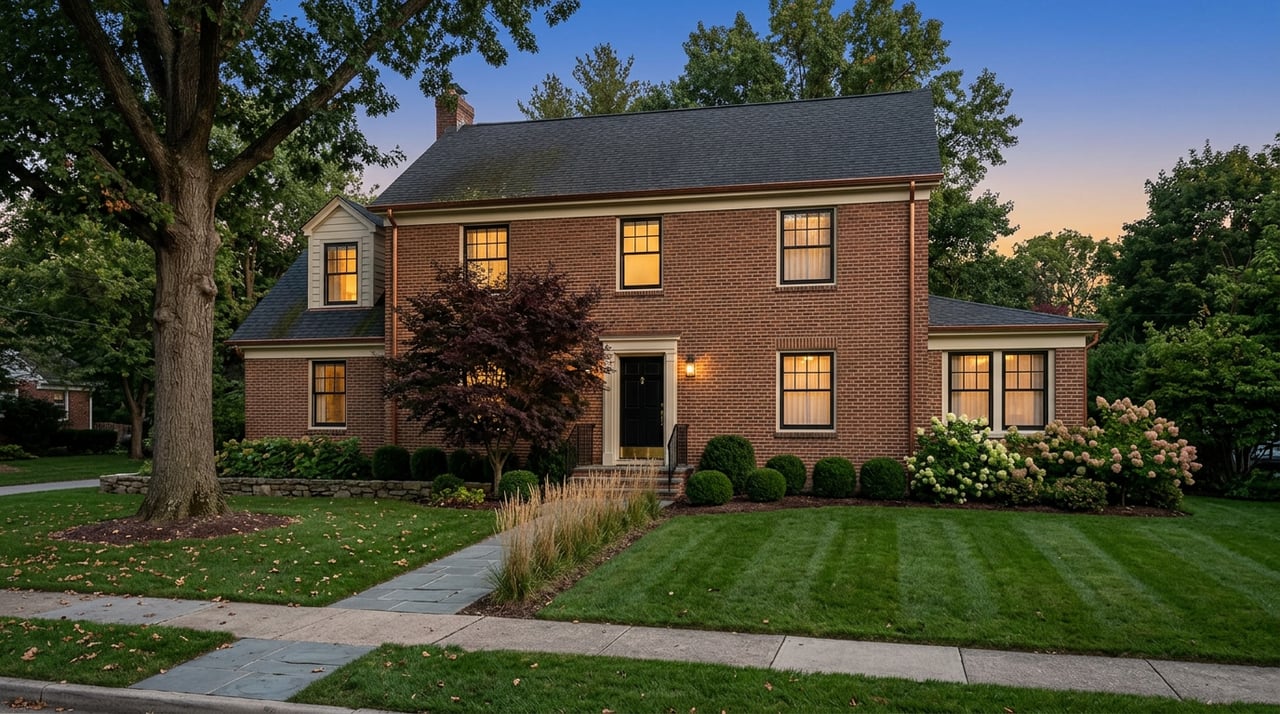
Winnetka Teardowns: How They Tighten the Real Estate Market
September 24, 2026
September 24, 2026
Last winter, a 1916 stucco Colonial on Hill Road went to closing before it ever really hit the open market. The nine-thousand-square-foot house, tucked on an acre near the Indian Hill golf course, was asking $4.25 million. It sold for $5.6 million, 32 percent over ask, and the sale included the furniture. The Real Deal later quoted listing agent Jena Radnay of @properties Christie's International Real Estate: "There is a total market for beautiful, well-furnished homes that you just had to put a key into," she said. "The market will pay up for that because we don't have any of it."
That sentence captures one part of Winnetka real estate in 2026, a market that also includes the $30 million lakefront sales that get the headlines.
Winnetka doesn't have a shortage of money or demand. It has a shortage of the specific thing an ordinary buyer actually wants: a finished, updated house they can move into without gutting it first. In March 2026, the village's median sale price stood at $1.7 million, up 7 percent from a year earlier, but only seven homes sold that month, down from twelve in March 2025. Zillow's home value estimate for Winnetka reached $1.9 million as of July 2026, up nearly 13 percent over the prior twelve months. Movoto recorded a $2.24 million median in May 2026, but only 48 homes closed that month against 70 a year before.
Three different data sources, three different numbers, one identical shape: prices climbing while the number of transactions shrinks. That is not what a healthy, well-supplied market looks like.
Meanwhile, demolition and construction are happening in plain sight, on building permits filed with the village.
Winnetka's demolition rules look strict on paper. The Village of Winnetka says a 2021 ordinance lets the Historic Preservation Commission delay the teardown of a designated significant home for up to 270 days, and it created a 20 percent building-size bonus for owners who preserve rather than demolish. In 2024, The Real Deal reported that the village added a separate ordinance limiting construction on the bluffs above Lake Michigan, a rule widely understood as a direct response to a much larger project that was already underway on Sheridan Road.
As The Real Deal reported, the compound cost $43.7 million to build on top of $33.7 million spent assembling three adjacent lots, and required stripping greenery and leveling steep bluffs to create a smooth walk to the water.
But delay is not denial, and that distinction matters more than the ordinance's language suggests. The Real Deal reported that Laura Good, an @properties agent who specializes in historic homes, sat on Winnetka's Historic Preservation Commission until she resigned after it failed to stop the demolition of the 1912 Clement Stone Mansion at 445 Sheridan Road. The commission fought that one hard, on record, over a series of 2024 meetings, and lost. A separate The Real Deal report says the owners bought the property in 2023 for $12.3 million and are now building a nearly 29,000-square-foot replacement, a project expected to cost $10 million in construction alone. The Real Deal quoted Good on the ordinance: "Our ordinance has no teeth in it and many people know that. And that's why in this community you see so many teardowns going on."
That's not a complaint from someone outside the process. It's an on-the-record verdict from someone who sat on the commission meant to enforce it.
| Property | Price | What It Shows |
|---|---|---|
| Windsor House, Sheridan Road | $31.25M (Aug. 2025) | Set the Chicago-area residential resale record, showing what buyers will pay for a fully restored, one-of-a-kind lakefront estate |
| 319 Sheridan Road (Godin listing) | Asking $29.9M (March 2026) | Previously listed at $24.8M in 2021; the nearly $5.1M jump reflects how far the top of the market has moved in five years |
| 674 Hill Road | $5.6M, 32% over ask (early 2026) | A furnished, move-in-ready home outside the lakefront tier still drew a bidding war |
| 445 Sheridan Road (Clement Stone Mansion site) | $12.3M purchase, ~$10M new construction | A historic home lost to demolition despite active preservation opposition |
| 81 Locust Road | $6M purchase (2024) to $14.9M listing (Aug. 2026) | An inland, non-lakefront home renovated with a pickleball court and golf simulator, then relisted near record territory |
Read across that table and the examples span price points. They include trophy lakefront estates, new construction and homes renovated or prepared for resale.
Not every home that disappears from the resale pool gets torn down. Some get renovated so thoroughly that they reappear in a completely different price bracket. The Locust Road estate is the clearest recent example: bought for $6 million in 2024, it returned to market in August 2026 asking $14.9 million after additions that included a pickleball court and a golf simulator. If it sells near ask, it becomes one of the highest-priced Winnetka sales of the year, behind only a Glencoe estate that closed for $17.5 million.
In The Real Deal, Dena Fox, an agent with the Rubenstein Fox Team at Baird & Warner, described the underlying constraint: "It's extremely hard to find land to build on. You're limited." When buildable land is scarce, the incentive to buy an existing, ordinary house and convert it into something else, whether by demolition or renovation, only grows stronger. These projects can change the price and type of homes available to buyers.
If you're weighing Winnetka against Glencoe, Kenilworth, or another North Shore town, the practical takeaway isn't about the $30 million sales at all. It's about what happens in the $1 million to $2.5 million range, where most family buyers are actually shopping. Expect competition even there. Expect that a genuinely move-in-ready home will draw multiple offers quickly, the way 674 Hill Road did. Expect that homes needing significant work will sell at a discount that reflects what a buyer would have to spend to bring them up to the same standard, because in this market, that math gets done by everyone at the table.
If you're on the selling side of an older or dated Winnetka property, this cuts the other way. A house that might look like a hard sell on a national portal, because of its age or its finishes, can be genuinely valuable here precisely because land and lot position matter more than the structure sitting on it. Winnetka's Village Council was also reported in mid-2026 to be working on a full rewrite of its zoning code, a process expected to take 18 to 24 months, since the current code is more than 40 years old. Rules around lot coverage, setbacks, and building size could look different by the time that process wraps, which is one more reason timing a sale or purchase around current rules, rather than assumed future ones, is worth a real conversation.
Does this scarcity only affect lakefront homes? No. The clearest recent example, 81 Locust Road, isn't on the lake. Examples of renovation and teardown appear across price tiers and locations in the village.
Is Winnetka's demolition ordinance likely to get stronger? The Historic Preservation Commission's own former members have said publicly that the current rule only delays demolition, it doesn't prevent it. The village's broader zoning rewrite, reported to be underway as of mid-2026, could eventually change some of these rules, but that process is still in its early stages.
What does this mean if I'm not shopping for a multi-million-dollar estate? It means budgeting extra time and expecting competition even in Winnetka's more modest price bands.
If you're trying to figure out what a specific Winnetka property, whether it's a candidate for renovation, a teardown lot, or a home you're hoping sells without a bidding war, is actually worth in this market, Deb Baker Homes offers a complimentary home valuation to help you see exactly where you stand before you list or make an offer.
This article is general information, not legal, tax or financial advice. Consult a qualified professional about your situation.
Get assistance in determining current property value, crafting a competitive offer, writing and negotiating a contract, and much more. Contact me today.